FIFA WORLD CUP 26™ KANSAS CITY
KC2026 Impact Report
A LETTER FROM PAM KRAMER, CEO OF KC2026
When Kansas City was named a host city for the FIFA World Cup 2026™, it was the result of years of work by many people. But it also marked the beginning of an even larger undertaking — one that would require the commitment, creativity and collaboration of an entire region to deliver on the world’s biggest sporting stage.
During the tournament, I kept a journal to capture the moments that reminded me why our work mattered so much. Not every day was perfect. On June 16, 2026, I summed it up in three words: “Peaks and valleys.”
But as the tournament progressed, something remarkable unfolded. On June 26, I wrote, “There is a shift that has happened. People are now focused on holding on to the moment, being part of the moment, not missing the moment. There is pride and joy and grace and gratitude. There is a collective exhale that comes with being able to believe in ourselves.”
That belief was earned — and demonstrates what is possible when this region works together. Public agencies and private companies, elected officials and civic leaders, community organizations, thousands of volunteers and individuals across Kansas and Missouri all pulled in the same direction to show the world who we are.
This report reflects on what we accomplished together: how we delivered on our commitments, engaged communities across the region, welcomed visitors from around the world and elevated Kansas City’s global profile.
It also looks candidly at what we learned, where expectations differed from reality and how those insights can help us prepare for future opportunities.
The World Cup™ gave Kansas City a remarkable moment on the world stage. What matters now is how we build on it. We have new relationships, greater visibility, valuable experience and a stronger foundation for what comes next.
And together, we’re poised to make the most of it.
A GLOBAL STAGE. A REGIONAL ACHIEVEMENT.
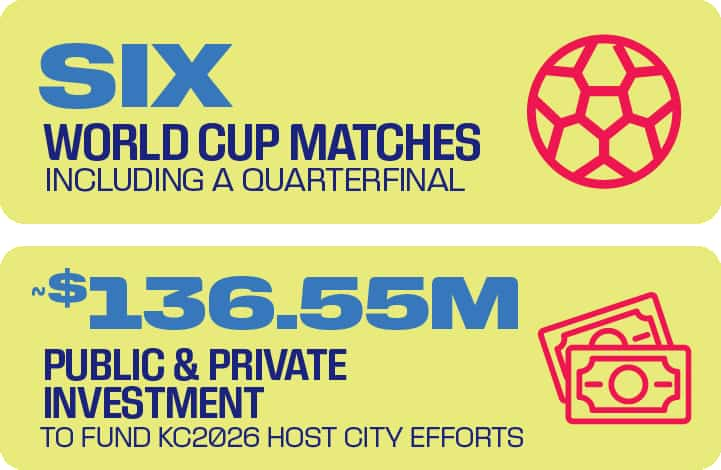
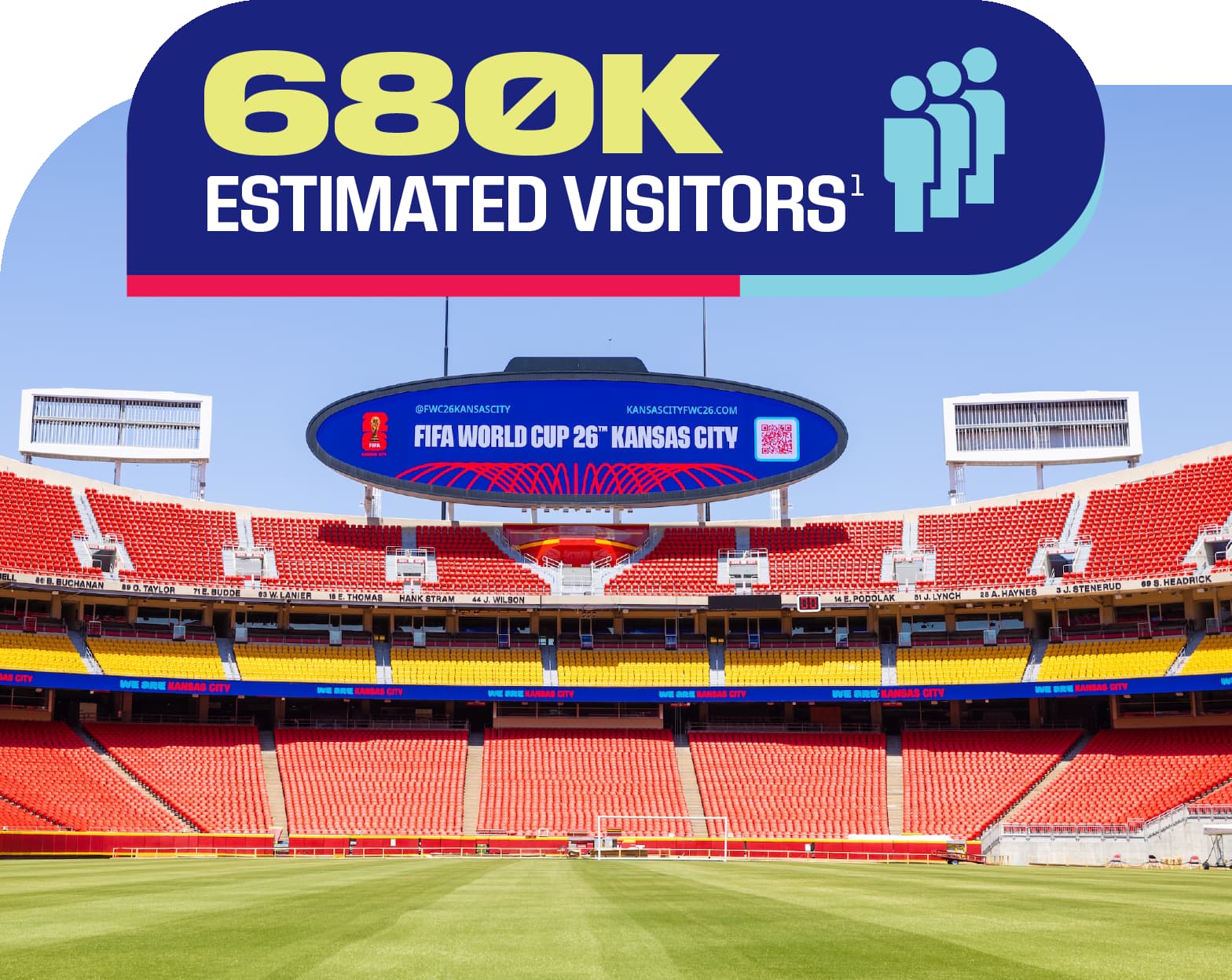
Kansas City delivered on its promise as a FIFA World Cup 2026™ Host City, welcoming an estimated 680,000 visitors who generated $570 million in direct visitor spending, according to Visit KC. Six matches, including a quarterfinal, brought the world’s biggest soccer tournament to the Heartland — and gave our region a global stage to showcase its passion for sports, hospitality and community spirit.
Public and private partners invested approximately $136.55 million in KC2026 efforts to fulfill our host city commitments, bring the World Cup experience to life across the region, engage communities and businesses, and build capabilities that will benefit Kansas City for years to come.
The State of Missouri, the State of Kansas, the City of Kansas City, Missouri, and Johnson County, Kansas, laid the foundation with their early financial commitments, active engagement and steadfast leadership, as did our professional sports teams: Sporting Kansas City, Kansas City Chiefs, Kansas City Royals and Kansas City Current.
Delivering the World Cup stage required years of planning and coordination at the Truman Sports Complex. The Jackson County Sports Complex Authority and Kansas City Chiefs worked closely with FIFA to prepare the stadium and coordinate complex operations, while the Kansas City Royals adjusted their regular-season schedule to accommodate World Cup matches. Together, their efforts helped make six historic World Cup matches possible and contributed to an unforgettable experience for fans.
Behind the scenes, years of planning and extraordinary collaboration across Kansas and Missouri made it all possible. Together, regional partners transformed the National WWI Museum and Memorial into a world-class FIFA Fan Festival™, created a temporary transportation network that doubled public transportation capacity, and developed a coordinated safety and security plan to protect teams, visitors and communities throughout the tournament.
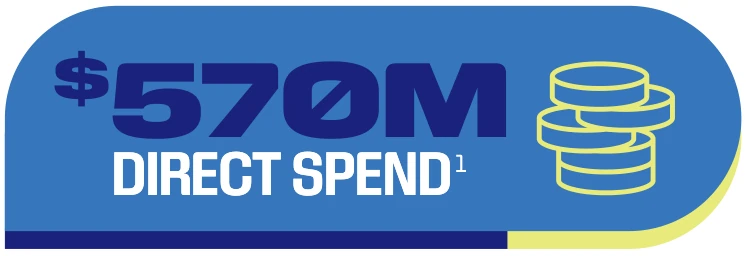
1 Source: Visit KC, press release, October 29, 2026.
WE NEVER AGAIN HAVE TO PROVE KANSAS CITY IS BIG ENOUGH TO HOST A GLOBAL EVENT.
– CLIFF ILLIG, HONORARY CO-CHAIR, KC2026 BOARD OF DIRECTORS
ONE REGION. UNITED IN ACTION.
TRANSPORTATION & MOBILITY
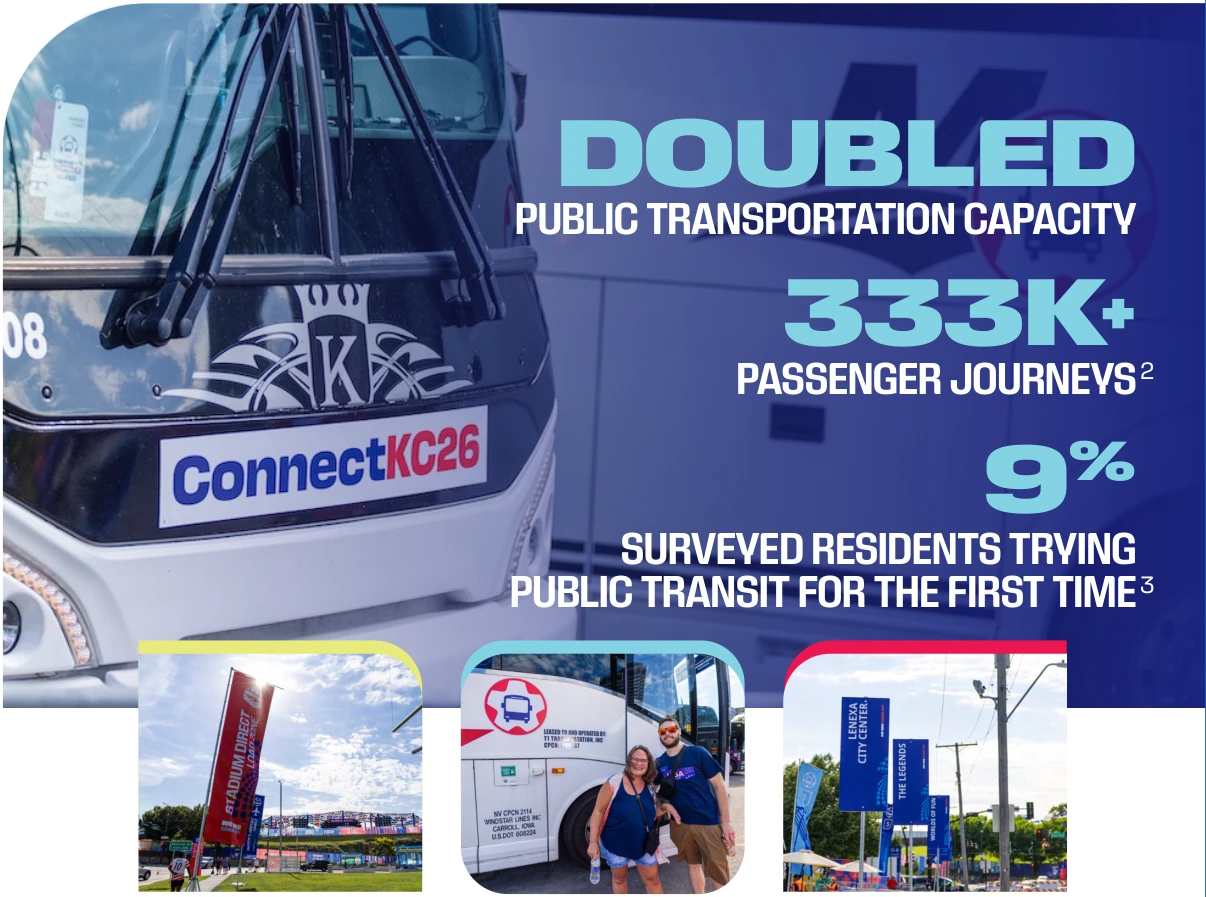
One of Kansas City’s greatest host city challenges was moving tens of thousands of fans to and from stadium matches without an existing public transportation system designed to accommodate that demand. KC2026 responded by creating ConnectKC26, a temporary transportation service that doubled regional public transit capacity during the tournament by integrating new bus service with existing transit networks to connect fans with matches, the airport and destinations throughout the region.
The expanded network delivered more than 333,000 passenger journeys, with strong ridership and positive passenger satisfaction.2 The World Cup also introduced residents to new ways of getting around the region, with 9% of surveyed residents trying public transportation for the first time.3 Beyond meeting the demands of the tournament, Kansas City established a scalable regional transportation framework to support large numbers of visitors and residents at future major events.
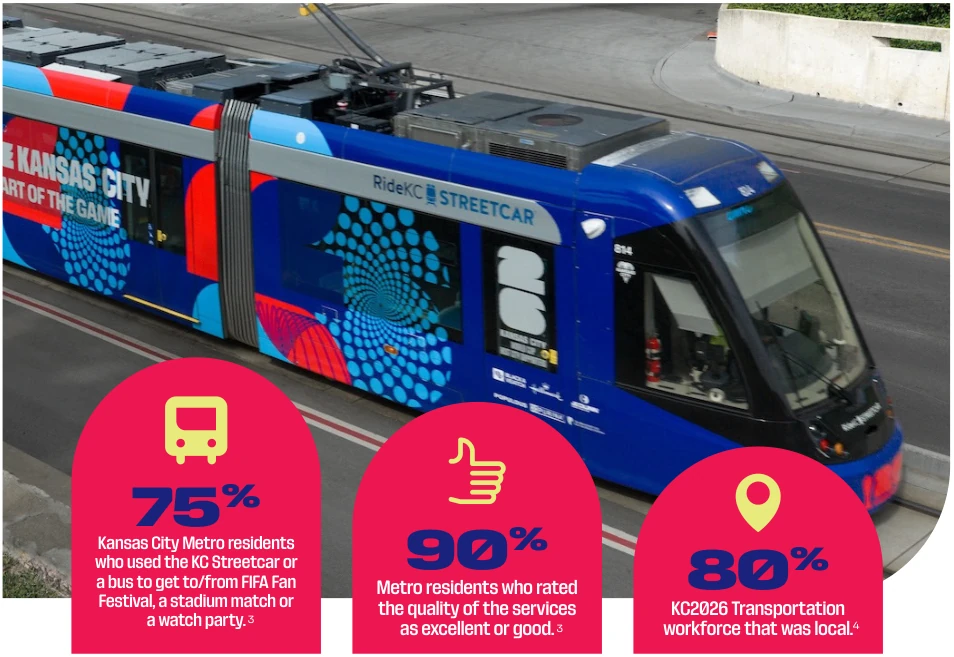
2 Source: KC2026 ConnectKC26 WRSTBND ticket data.
3 Source: ETC Institute 2026 Post Tournament Transportation Survey.
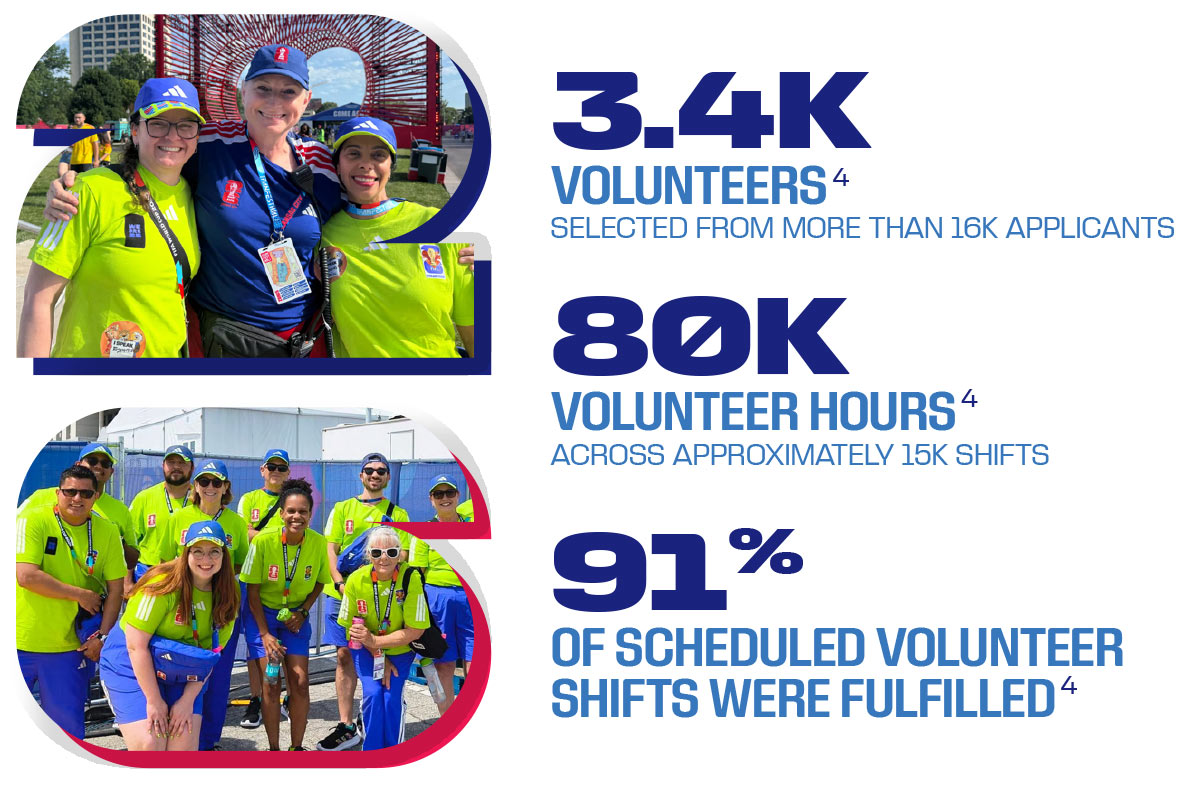
4 Source: KC2026.
SAFETY, SECURITY & REGIONAL COORDINATION
Moving people across the region was only one part of the challenge. Protecting teams, visitors and communities required an equally ambitious level of coordination across multiple jurisdictions, venues and activities.
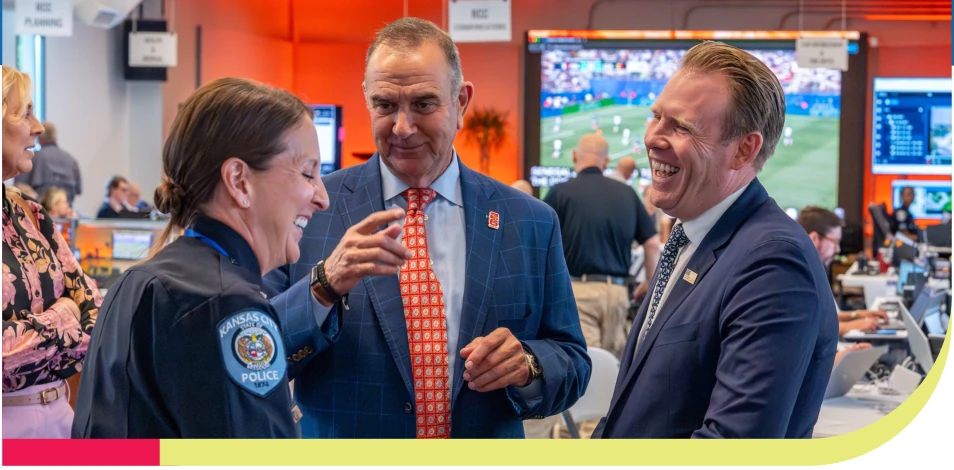
At the heart of this effort was the Joint Operations Center (JOC), which brought transportation, public safety, emergency management, healthcare, weather, communications and other operational partners together under one roof throughout the tournament. Operating up to 19 hours a day, the JOC enabled partners to monitor activity at key locations, including Kansas City Stadium parking lots, FIFA Fan Festival™, national team base camps and KC•House. JOC partners also tracked transportation networks, team and traffic movements, and changing weather conditions, sharing information and coordinating responses to emerging issues in real time.
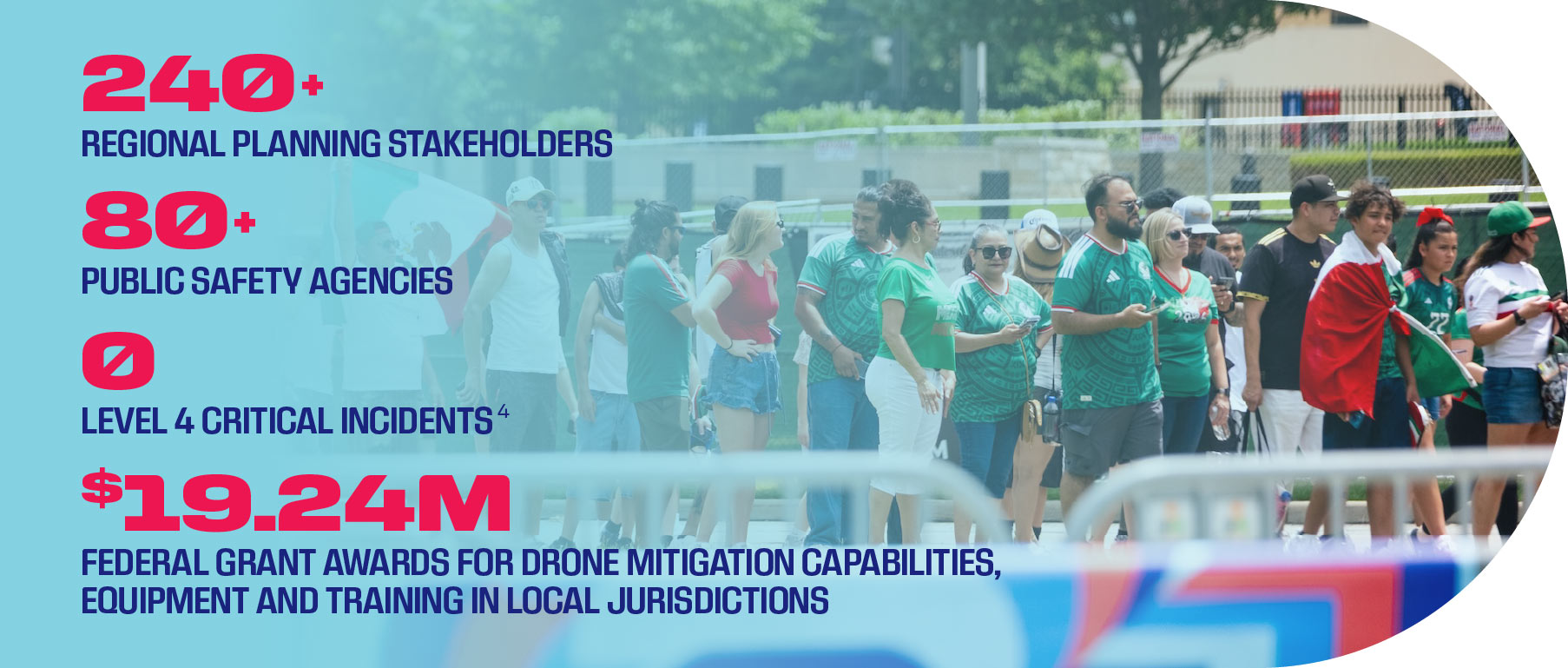
More than 240 regional stakeholders helped plan tournament operations, with more than 80 public safety agencies supporting their delivery. Together, partners coordinated 8,000 miles of police escorts, supported historic investments in drone mitigation and helped deliver a tournament with zero Level 4 critical incidents recorded in the regional safety and security summary.4
The JOC demonstrated what Kansas City can accomplish when an entire region works together, establishing a tested model for coordinating major events and strengthening regional preparedness for the future.
4 Source: KC2026.
5 Source: Pete’s Garden World Cup After Action Report.
6 Source: KC Can Compost post-tournament report.
HUMAN RIGHTS & SUSTAINABILITY
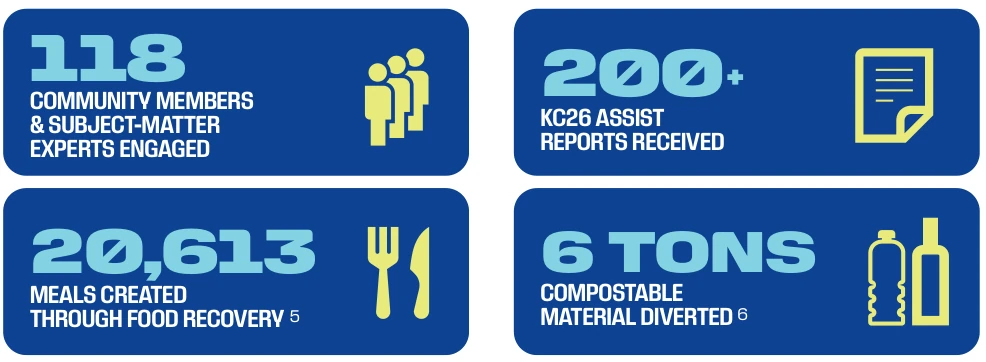
As part of FIFA’s host city requirements, KC2026 worked with regional partners and community stakeholders to develop and implement a Human Rights Action Plan that addressed accessibility and inclusion, human trafficking prevention, worker protections and mechanisms for reporting and resolving concerns. Informed by input from 118 community members and subject matter experts, the plan guided practical actions across tournament planning and operations. KC26 Assist provided an accessible digital channel for fans, visitors and residents to report nonemergency safety concerns, receiving more than 200 reports that were routed to appropriate response teams.
Sustainability partnerships also delivered measurable community benefits. Pete’s Garden recovered nearly 25,000 pounds of surplus prepared food from World Cup activities, creating more than 20,000 meals for Kansas City families.5 At FIFA Fan Festival, KC Can Compost diverted six tons of compostable material from the waste stream, demonstrating how major events can support local organizations and advance responsible resource management.6
FIFA FAN FESTIVAL™ KANSAS CITY
WAS A HIGHLIGHT OF THE TOURNAMENT.
A WORLD-CLASS CELEBRATION. UNMISTAKABLY KANSAS CITY.
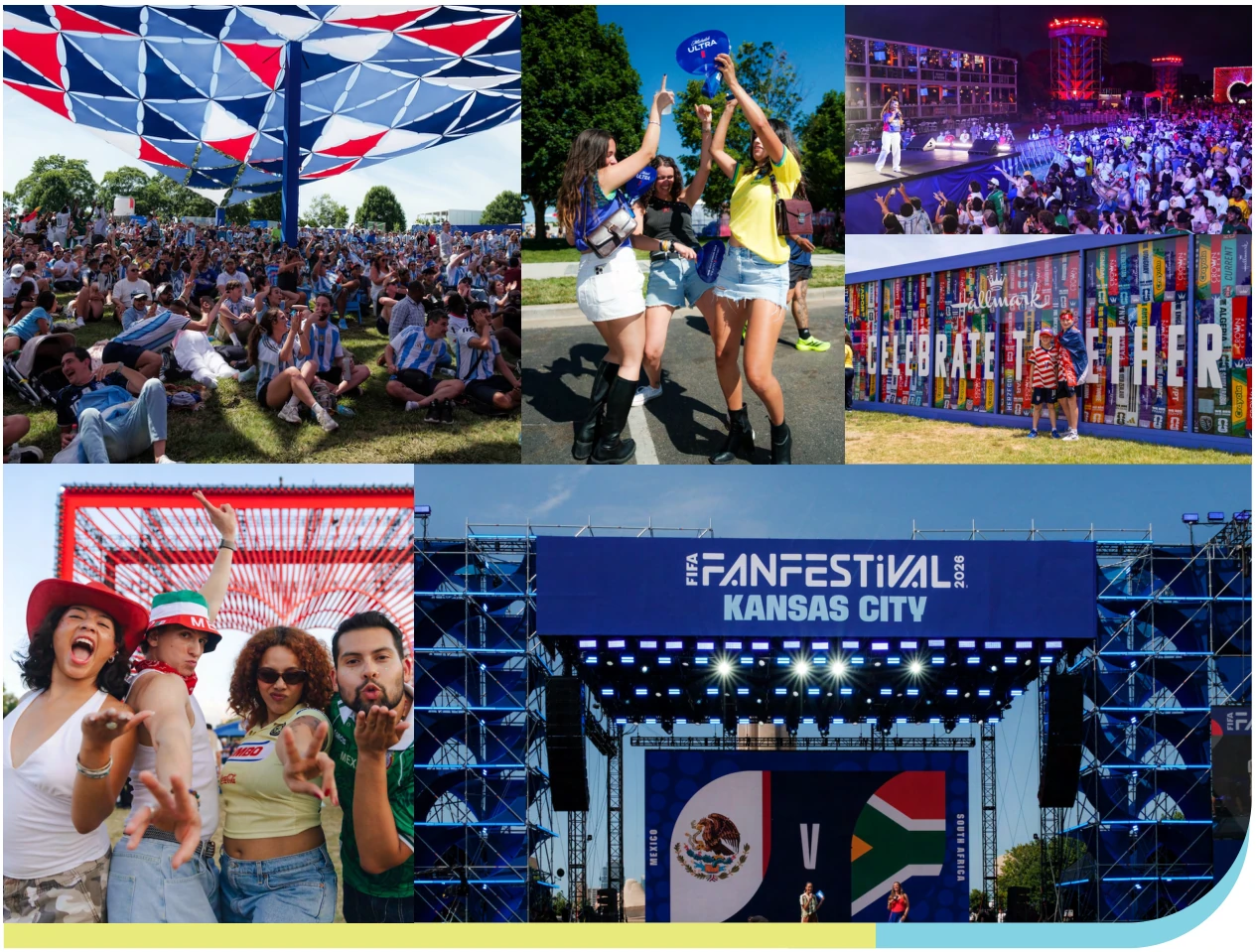
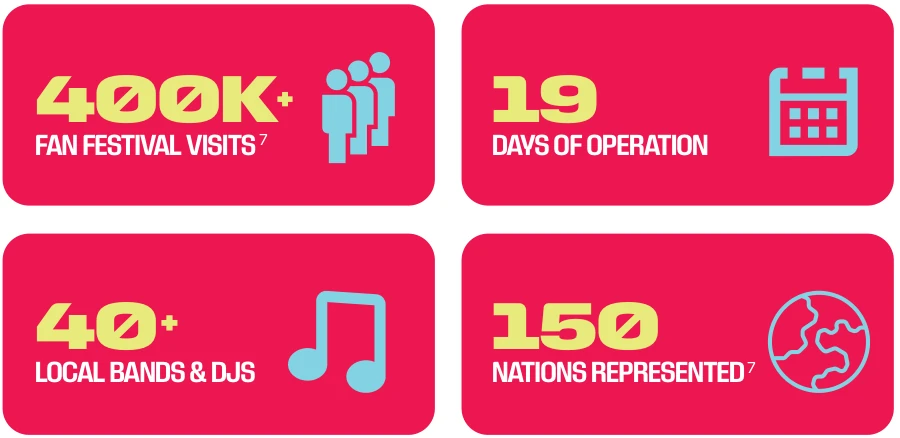
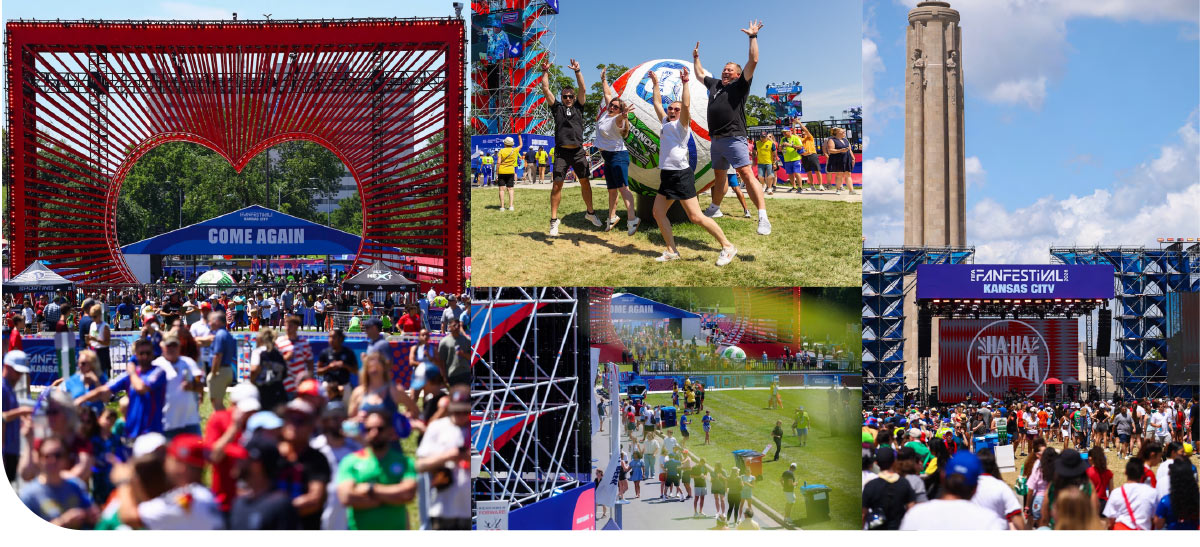
For 19 days, the grounds of the National WWI Museum and Memorial became the heart of Kansas City’s World Cup celebration. Free and open to all, FIFA Fan Festival™ Kansas City welcomed more than 400,000 visitors, bringing fans from around the world together to share their passion for soccer, music, food and culture.7
Behind the excitement was a major event production, years in the making. KC2026 and its partners brought together world-class entertainment, live match broadcasts, local performers and food vendors, sponsor experiences and the infrastructure and operations needed to welcome tens of thousands of fans each day.
Nationally recognized headliners shared the stage with more than 40 local bands and DJs, while fans enjoyed live broadcasts of more than 35 FIFA World Cup matches. From the energy of the crowds to the iconic backdrop of the Memorial, the festival showcased the creativity, hospitality and community spirit that make Kansas City special.
More than a place to watch matches, FIFA Fan Festival became a gathering place for the world — and a powerful demonstration of Kansas City’s ability to produce an international celebration on a remarkable scale.
7 Source: KC2026 FIFA Fan Festival™ registration and entry data (WRSTBND platform), June 11 to July 11, 2026. Attendance reflects passes scanned at entry; origin reflects the home ZIP code or country provided at registration.
A REGION THAT MADE THE WORLD CUP ITS OWN.
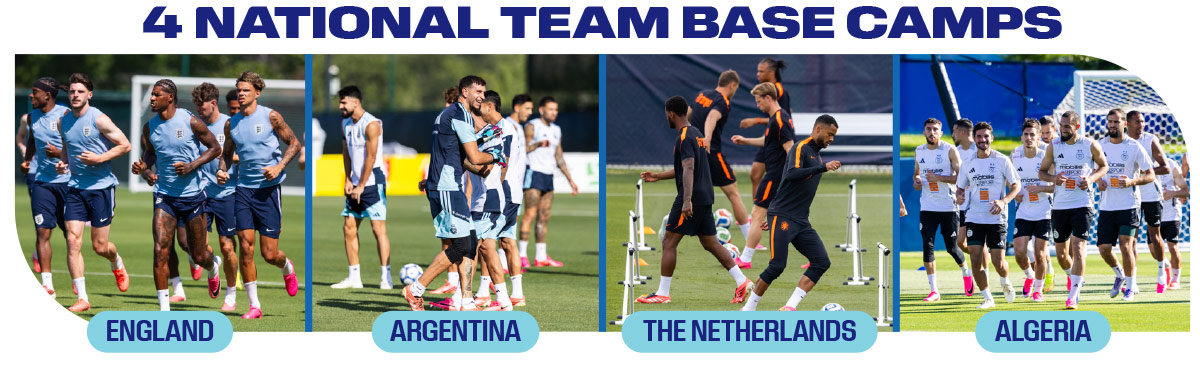
Kansas City’s identity as the Soccer Capital of America® was built over decades through investment in the sport, world-class facilities and a passionate soccer community. That foundation helped attract four national team base camps, including three top-ranked teams, bringing some of the world’s best and most visible players to train and prepare in our region. The teams were hosted at world-class facilities by Sporting Kansas City, Kansas City Current and The University of Kansas.
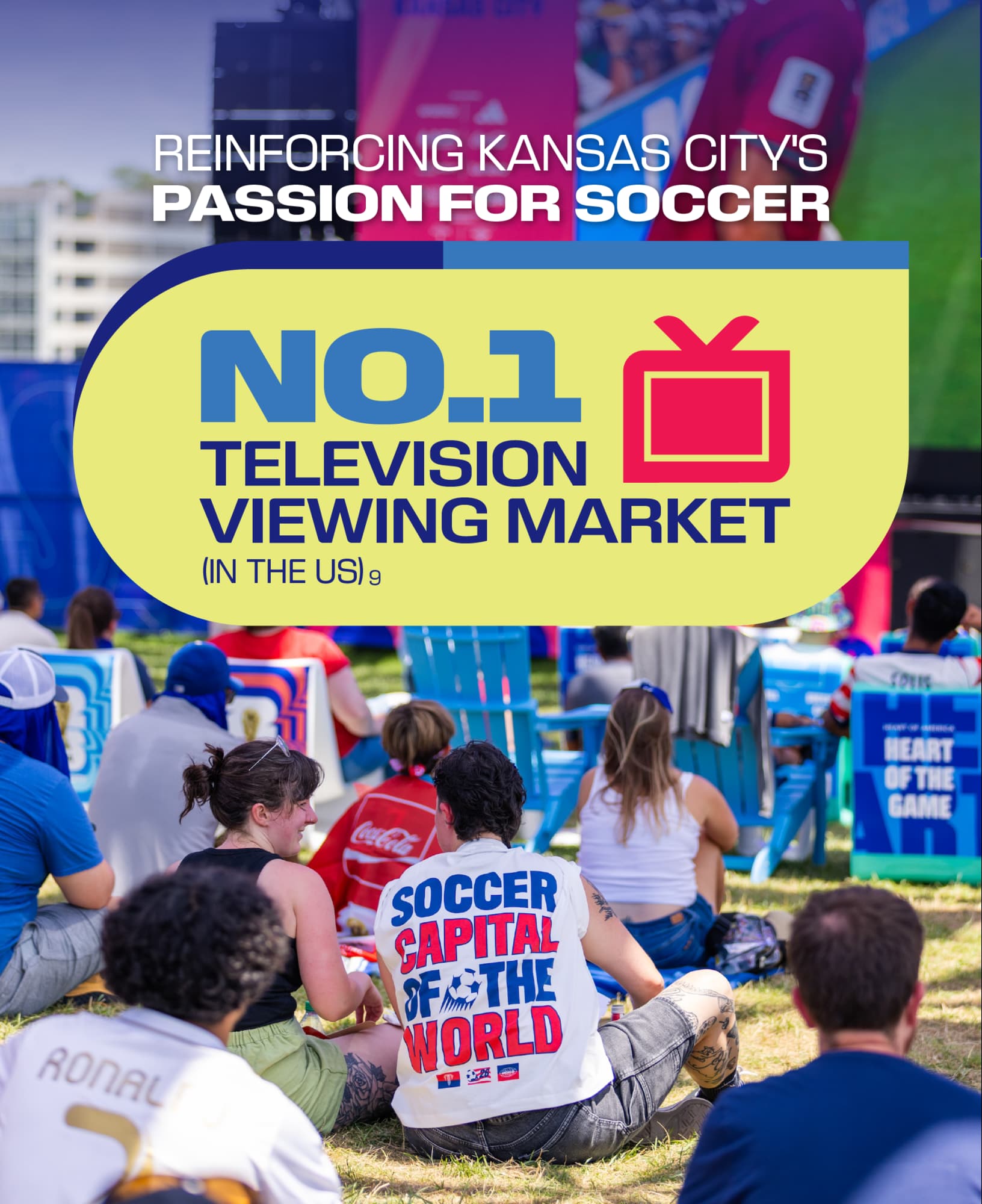
But it was our people who made the World Cup distinctly Kansas City. Volunteers, fans, businesses and communities across both states embraced the tournament. Whether cheering at matches, gathering for watch parties or tuning in from home, Kansas Citians demonstrated their passion for the game, making Kansas City the No. 1 U.S. television viewing market for the World Cup.9
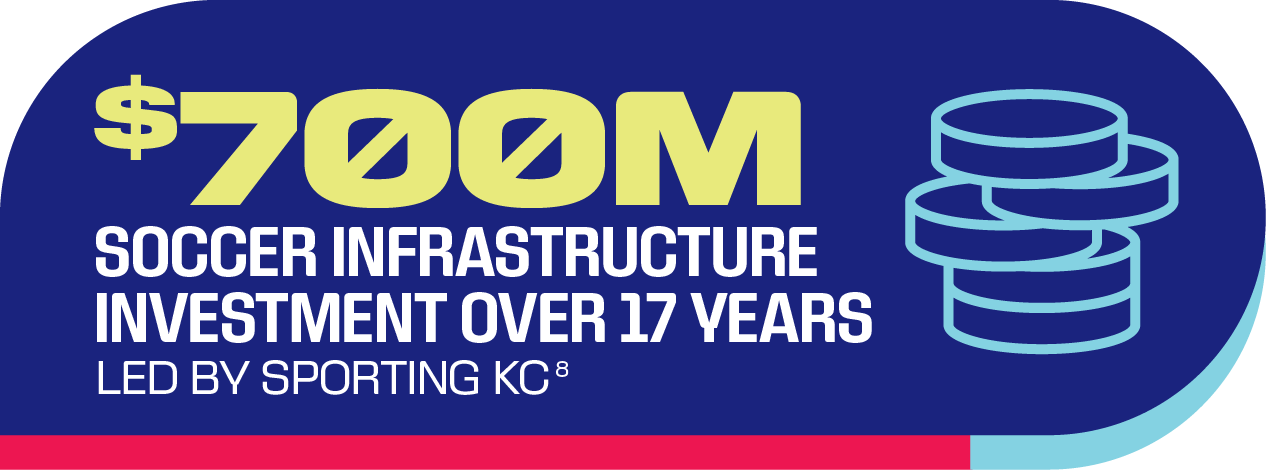
8 Source: Fortune, news story, July 2026.
9 Source: FOX Sports using Nielsen television ratings.
COMMUNITY PRIDE IN ACTION.
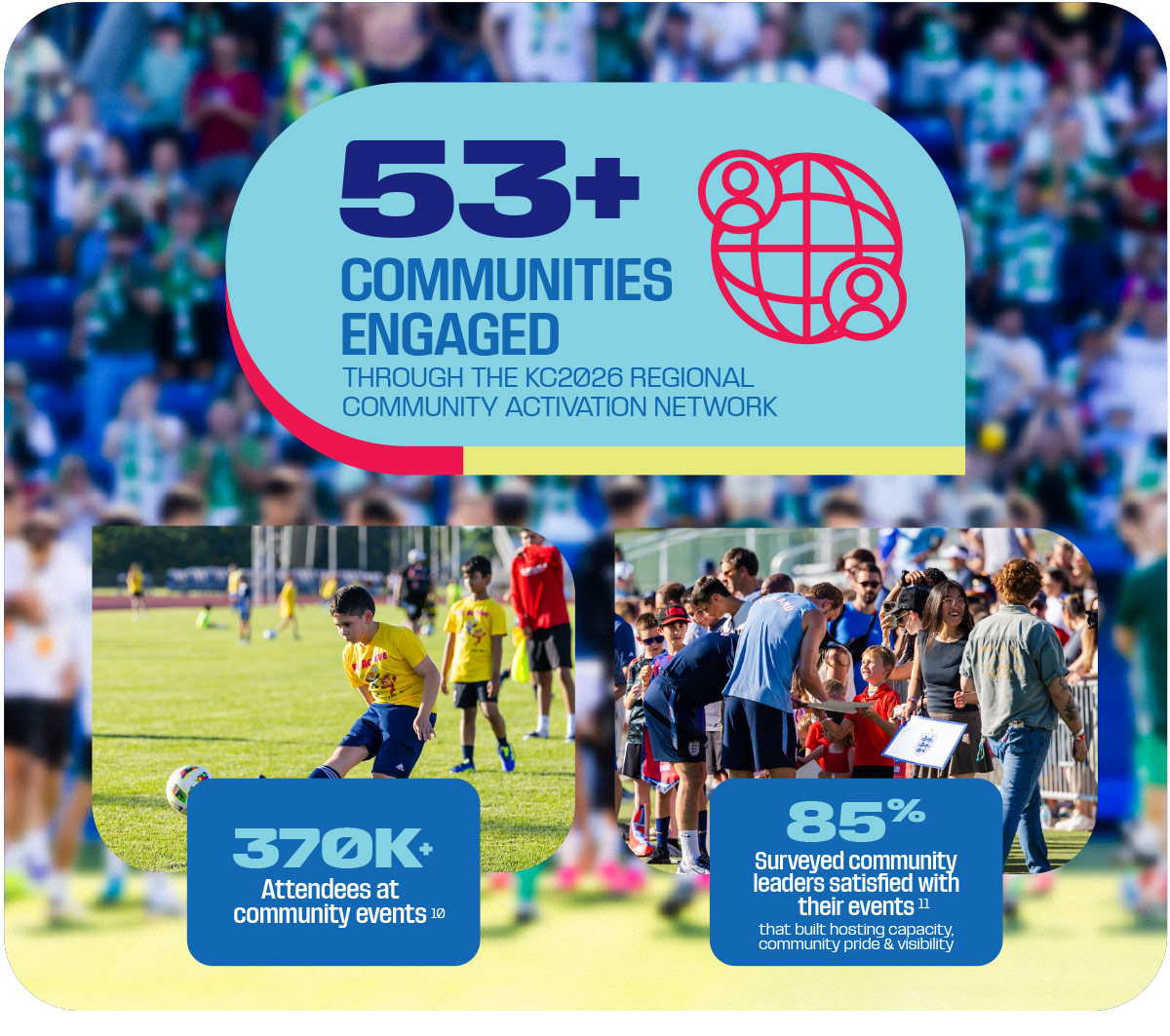
Across Kansas and Missouri, more than 50 communities made the World Cup their own, organizing watch parties, festivals and celebrations that brought neighbors together and extended the excitement beyond the stadium. Base camp communities embraced their adopted national teams, celebrating the customs and traditions of visiting countries and creating opportunities for residents to connect with the world’s game.
Thousands of volunteers, ranging in age from 18 to over 70, answered the call with extraordinary dedication. Soccer fans or not, they served through challenging weather and long days, taking on whatever was needed with enthusiasm and pride and bringing Kansas City’s trademark hospitality to life.
Together, these efforts demonstrated the remarkable power of a region united by a shared purpose.
4 Source: KC2026.
10 Source: KC2026 Community Events & Activation Network participants providing self-reported event information to KC2026.
11 Source: KC2026 Post Tournament Community Events & Activation Survey.
ALL IN FOR KANSAS CITY.
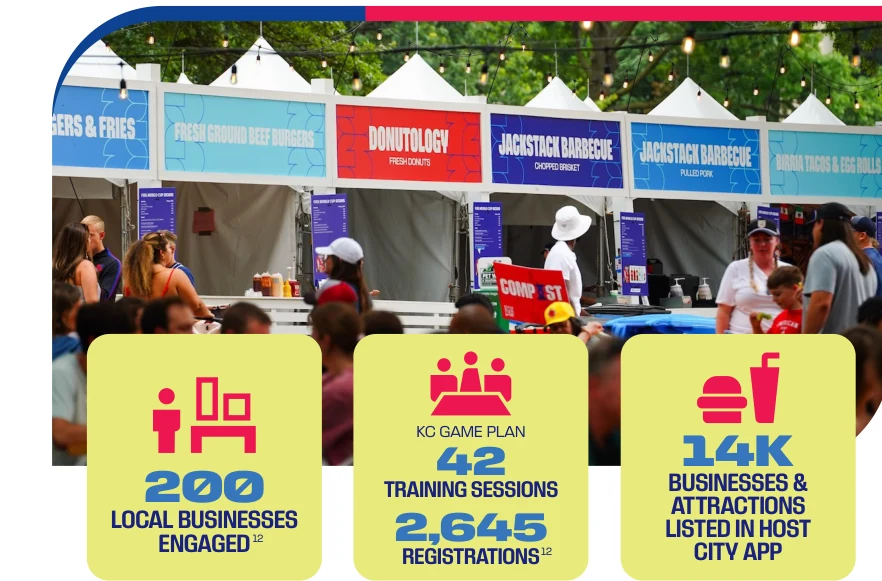
Kansas City’s business community played a vital role in bringing the World Cup to life. Approximately 200 local businesses and organizations were engaged through sponsorships, partnerships and the provision of products and services essential to delivering the tournament. Large and small, these businesses brought more than financial resources, products and services. They brought ingenuity, relationships and a shared determination to show the world a Kansas City that is capable, innovative and welcoming.
Through KC Game Plan, KC2026 and regional partners created the first mega-event playbook to help small businesses prepare for visitors with practical training, tools and resources. Tourism partners also joined forces to create the region’s first digital visitor platform, connecting fans with more than 14,000 local businesses and attractions across Kansas and Missouri.
Together, these efforts reflected a business community invested not just in hosting the World Cup, but in Kansas City’s future.
Official Host City Supporters


Professional Sports Teams



12 Source: KC2026, KC Game Plan Data.
HOST CITY CHAMPIONS
Coaches Level
Burns & McDonnell, Evergy, Google, Sysco, BOK Financial, Helzberg, Ewing Marion Kauffman Foundation, McCownGordon Construction, Metropolitan Community College/CommunityAmerica Credit Union, Tompkins Industries, Alaris Capital.
Keepers Level
Airshare, CBRE & Monarch Build, Convergence KC, Crain Capital, Deloitte, Enterprise Mobility, Greater KC Chamber of Commerce, HNTB, Husch Blackwell, KC Area Development Council, Lathrop GPM, Lockton, Netsmart, Polsinelli, Trozzolo, Two Circles, UMB Bank, Union Broadcasting/Sports Radio 810, Walz Tetrick Advertising.
HOSPITALITY IS OUR LOVE LANGUAGE.
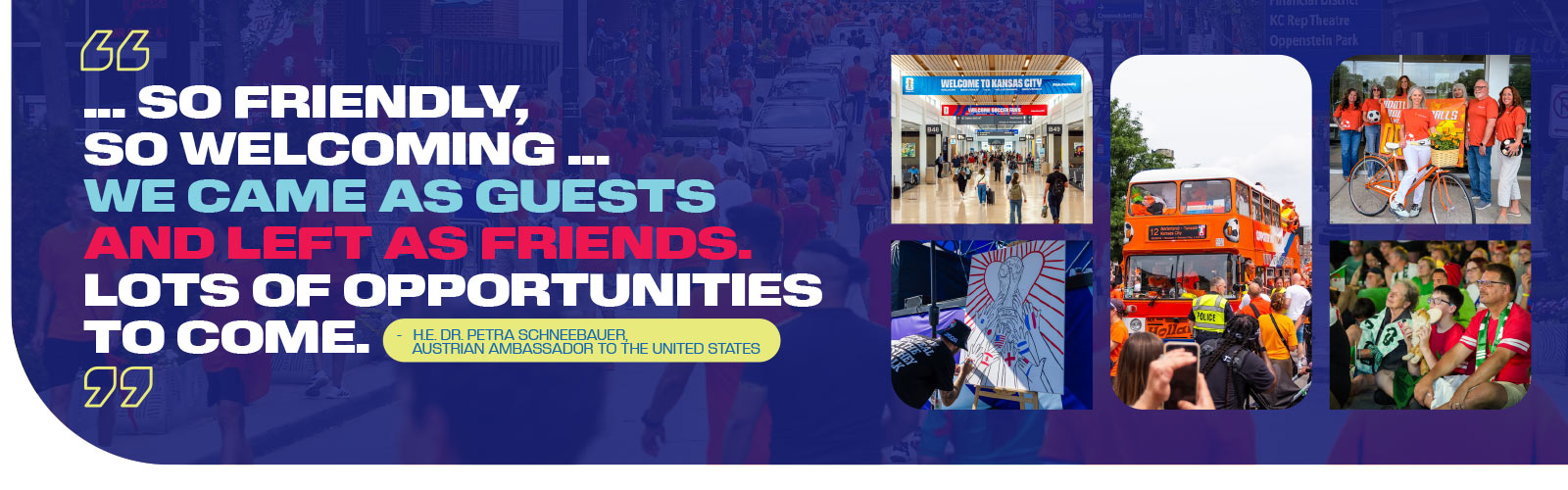
Kansas City’s hospitality was on display from the moment visitors arrived. Coordinated signage, colorful murals and FIFA World Cup displays transformed the airport, streetcar corridor and communities across the region into a celebration of the world’s game. The excitement extended far beyond the stadium, creating a festive atmosphere that welcomed visitors and brought the tournament to life throughout Kansas City.
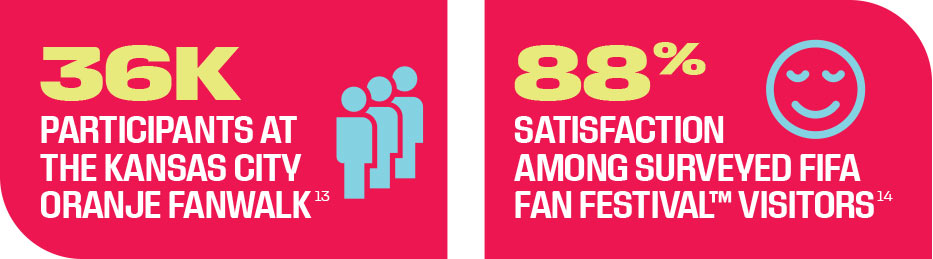
But our most memorable welcomes were personal. From Lawrence’s embrace of Algeria and Riverside’s celebration of the Netherlands to Prairie Village neighborhoods dotted with signs welcoming England, communities made visiting teams and their supporters feel at home. Argentina’s banderazo and the extraordinary Oranje Fanwalk, along with countless spontaneous encounters, created memories and friendships that transcended borders.
13 Source: EB Systems Beacon Data.
14 Source: KC2026 Kansas City Brand Impact Research, August 2026.
AN INVITATION THAT OPENED DOORS.
Kansas City extended its hospitality beyond the stadium through free celebrations, helpful visitor information and experiences that encouraged visitors to explore the region and connect with its people.
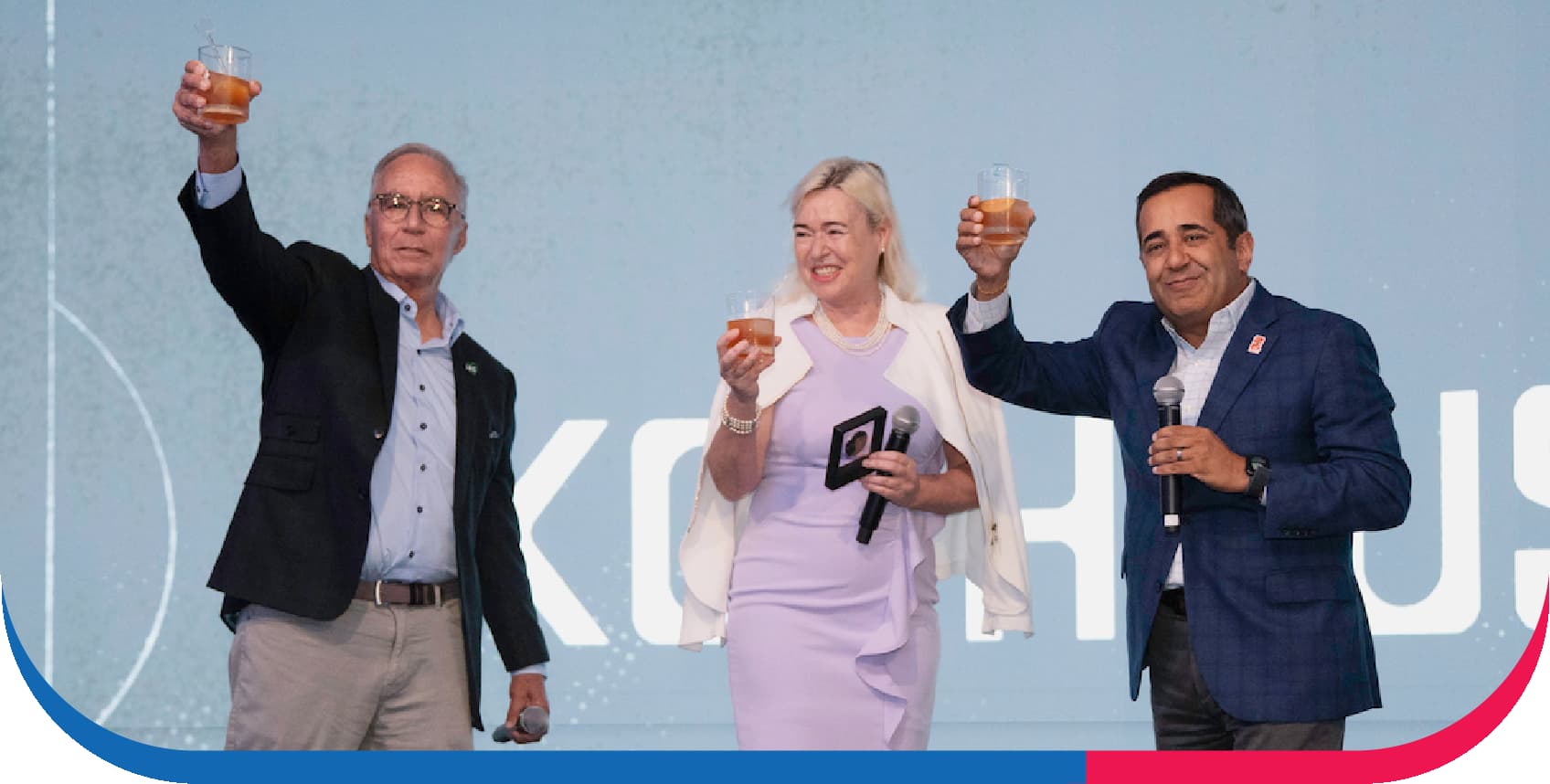
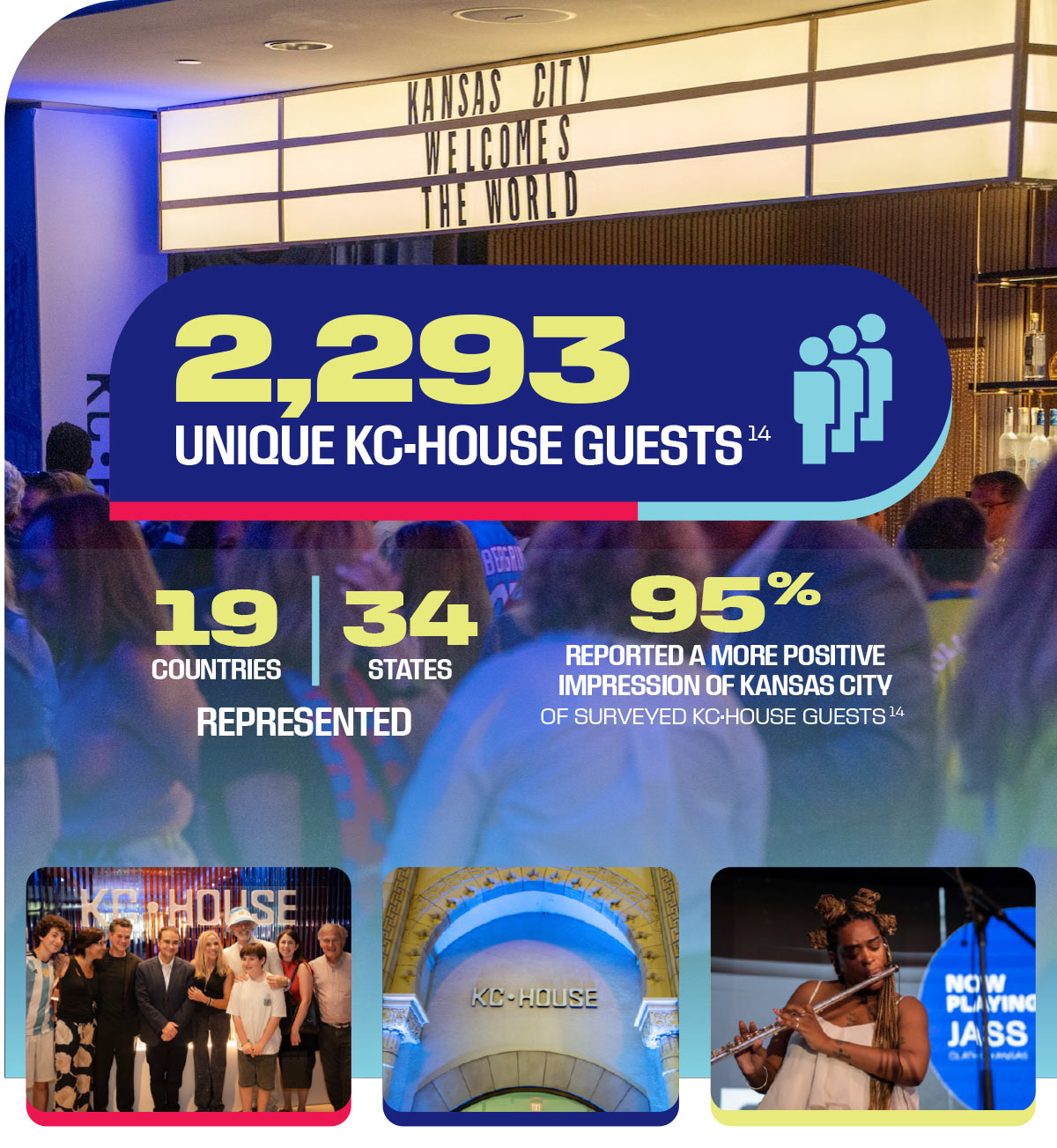
At KC•House, that invitation became more personal. International guests, ambassadors and business leaders were introduced to Kansas City through meaningful conversations with the people shaping our region’s future. These encounters showcased Kansas City’s strengths in healthcare, bioscience, agriculture, sports architecture and infrastructure, while experiences featuring local artists, chefs and performers revealed a creative and vibrant side of our region that many guests hadn’t expected.
KC•House demonstrated that hospitality can do more than make visitors feel welcome. It can change perceptions, build relationships and open doors for future collaboration.
14 Source: KC2026 Kansas City Brand Impact Research, August 2026.
ALL EYES ON US.
For five weeks, Kansas City captured the attention of audiences around the world. Proactive international media outreach, including a special KC•House event for more than 70 journalists, helped bring our story to global audiences. Meanwhile, journalists covering national teams based in our region spent extended time here, creating opportunities for deeper storytelling.
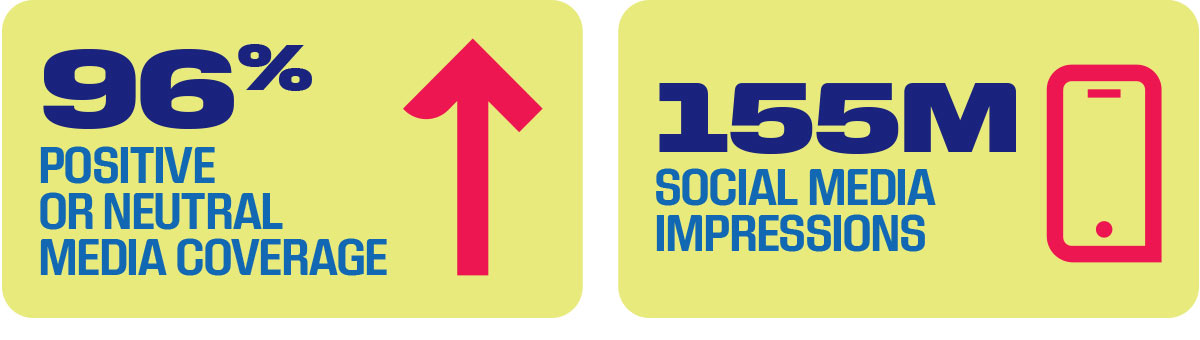
From The New York Times and The Guardian to Reuters and international sports media, coverage showcased our soccer culture, hospitality and ability to host on the world’s biggest stage. Unforgettable moments on the pitch added to the global spotlight, amplifying Kansas City’s story at a scale traditional destination marketing could rarely achieve.
THE BEST HOST CITY OF ALL.
– DON GARBER, MLS COMMISSIONER
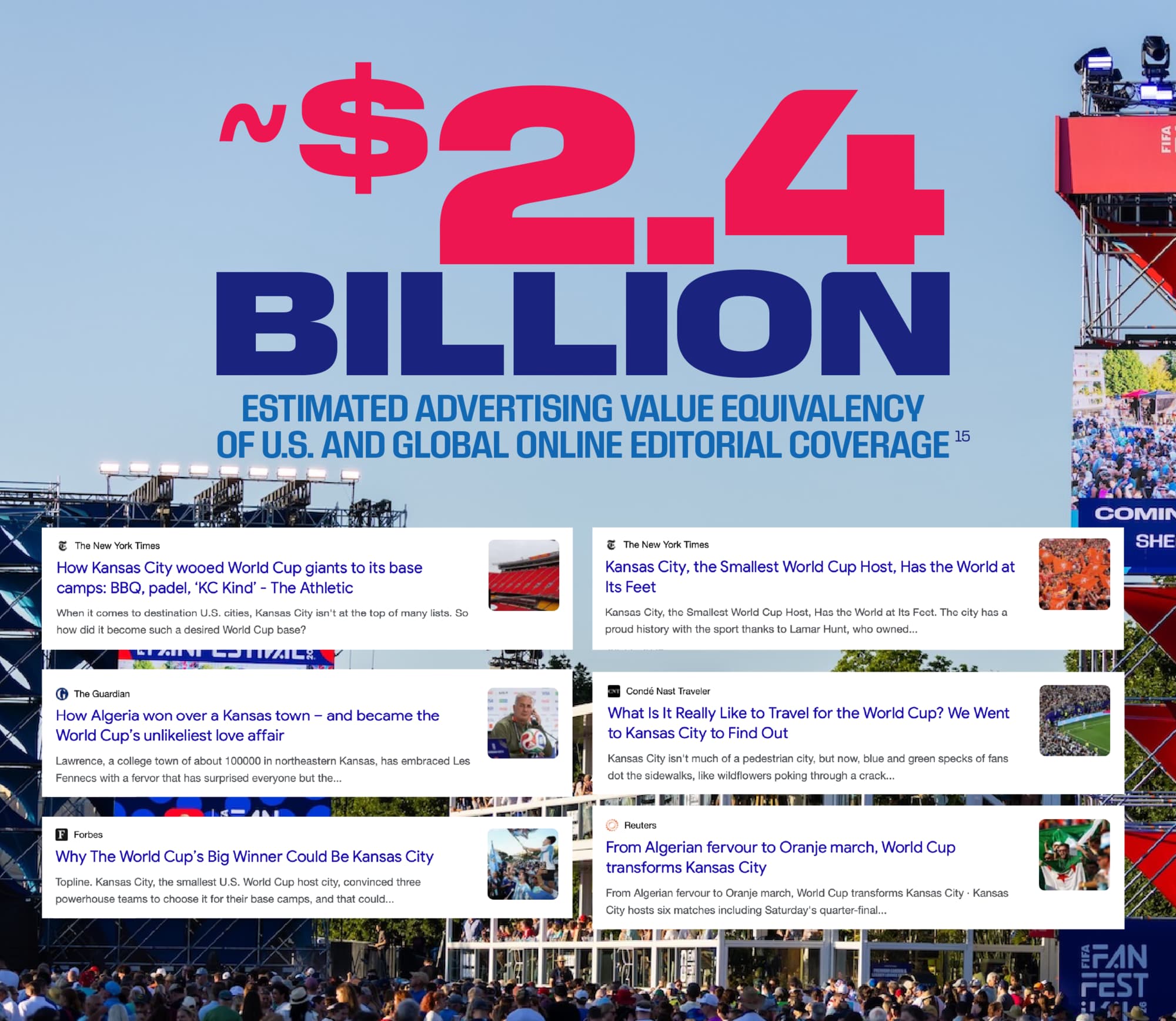
15 Source: Meltwater, Advertising Value Equivalency (AVE) analysis of U.S. and international online editorial media coverage published May 1–July 24, 2026. AVE represents the estimated cost of purchasing equivalent advertising space and does not reflect actual advertising expenditure or revenue.
KANSAS CITY. SEEN IN A NEW LIGHT.
Just as important as the attention Kansas City received was the impression we made. Visitors discovered a welcoming, vibrant region with the facilities, talent and ambition to compete on a global stage. The KC Heart Gateway™ at FIFA Fan Festival™ became a signature landmark, celebrating our regional identity in images shared around the world.
Post-tournament research found increased awareness of Kansas City, stronger perceptions of our region and a willingness among visitors to return for future events.
These gains represent an opportunity extending well beyond the World Cup. Greater visibility and a stronger reputation can attract future visitors, business investment, talent and international partnerships, creating value for our region for years to come.
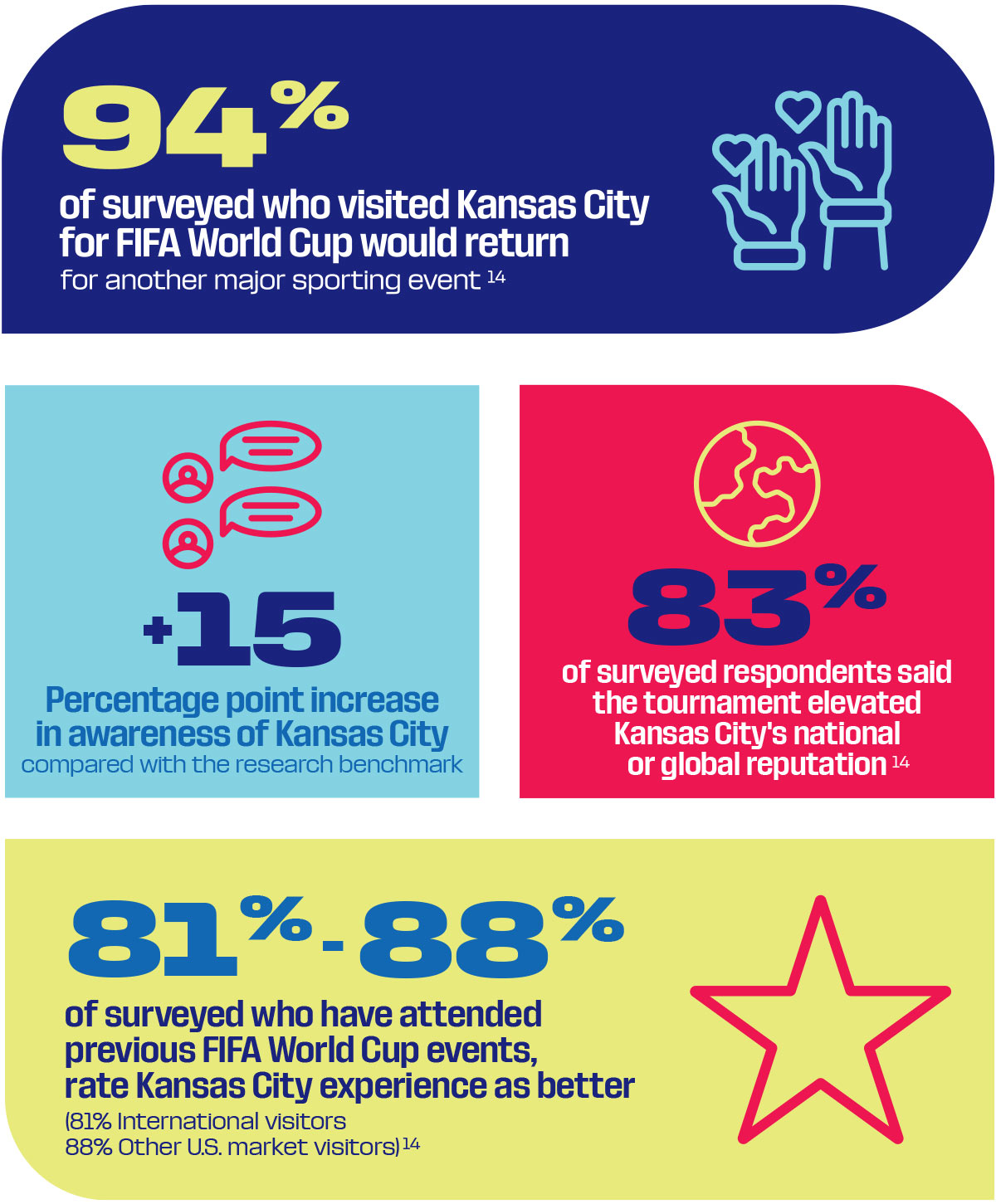
14 Source: KC2026 Kansas City Brand Impact Research, August 2026.
THE MOMENT WAS JUST THE BEGINNING.
The FIFA World Cup 2026 was an extraordinary moment for Kansas City, but its lasting value will be determined by what we do next.
Hosting strengthened relationships across Kansas and Missouri, expanded our international connections and demonstrated and built confidence in what we can accomplish through regional collaboration. Those relationships are already creating opportunities for business investment, innovation and future major events.
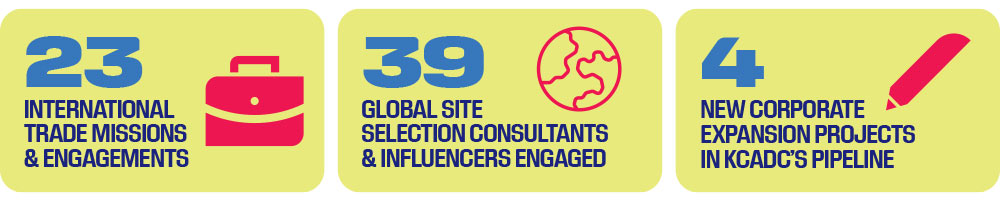
Through KC•House and other international engagements, Kansas City connected with prospective investors, global site selection consultants and business leaders. Conversations initiated during the tournament are advancing new partnerships and economic development prospects.
These early opportunities demonstrate what is possible when global visibility is paired with intentional relationship-building. The challenge now is to turn that momentum into sustained growth for our region.
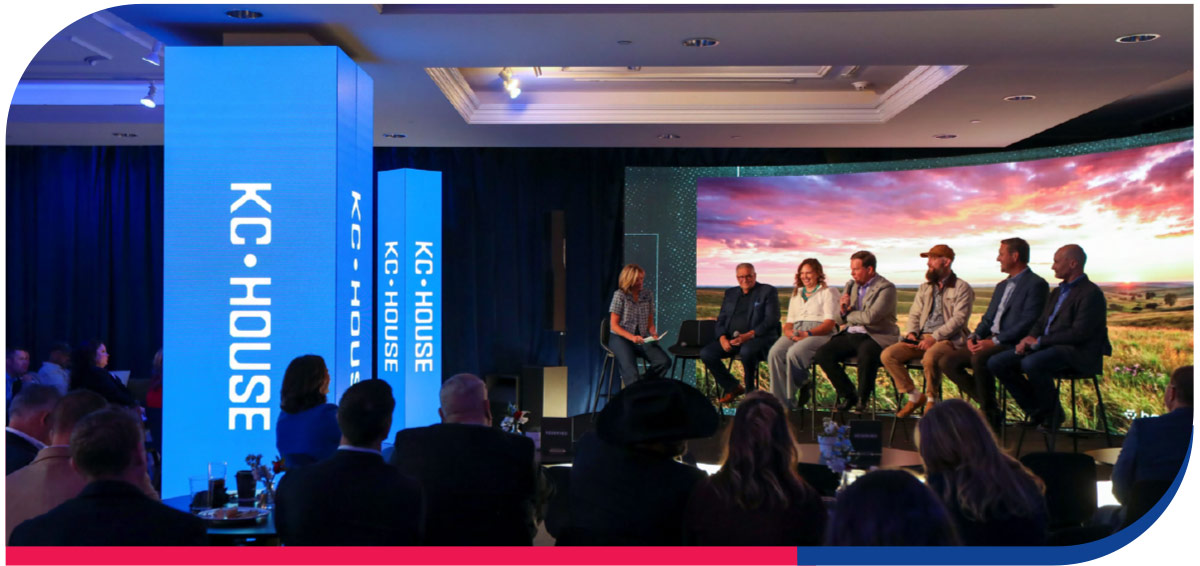
The Yield Lab Institute launched its Global Cattle Innovation Platform at KC•House in June 2026, connecting leaders in agriculture, research and investment. The Kansas City-based initiative subsequently secured foundational funding from the Bezos Earth Fund to advance innovation in global beef and dairy production.
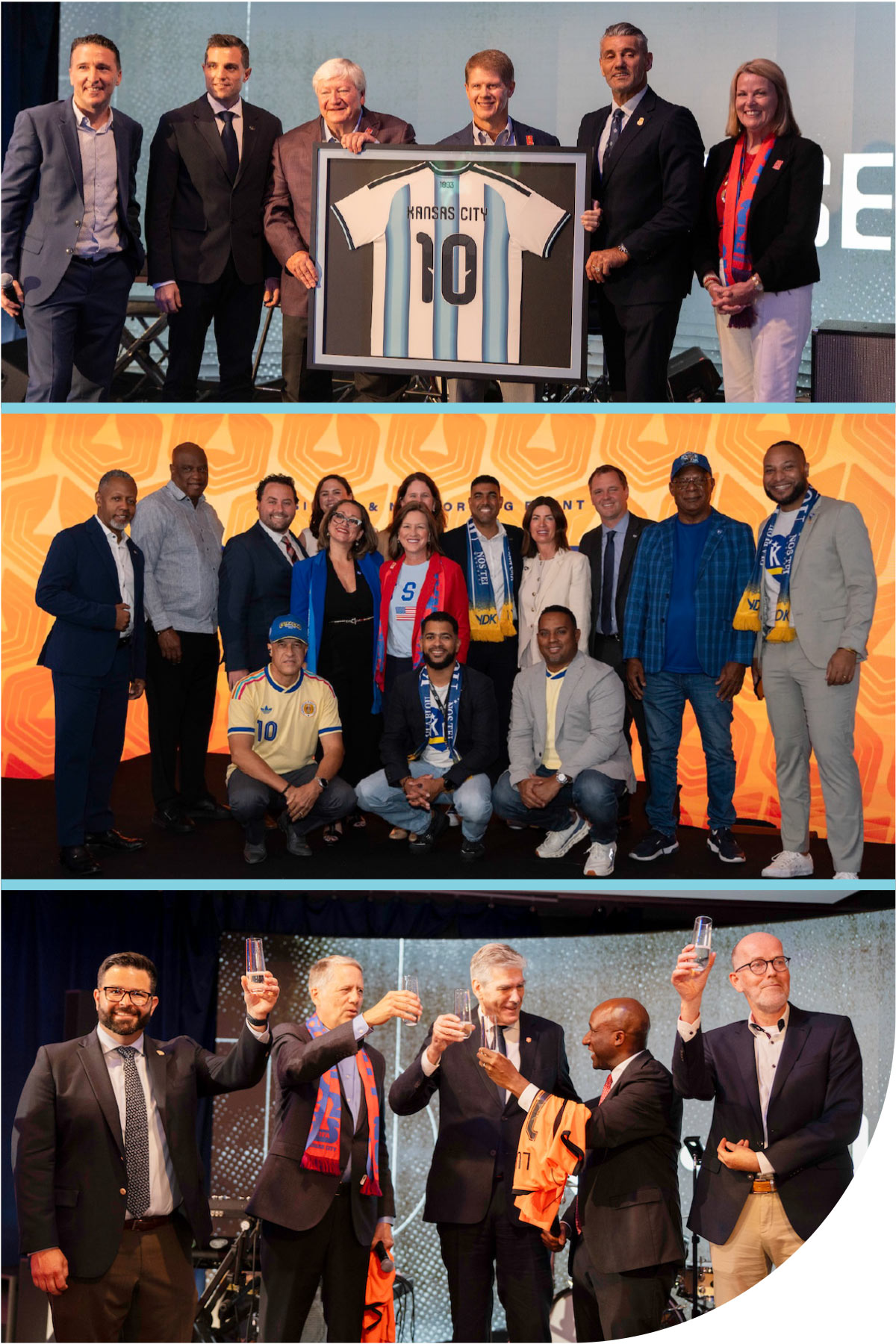
FROM EXPERIENCE TO ACTION.
Hosting the World Cup gave Kansas City more than memories. It created practical experience, planning resources and stronger working relationships that can help our region pursue opportunities with greater confidence.
That learning continues. Communities, businesses and organizations are evaluating their experiences as additional research and economic data provide a fuller picture of what worked, where expectations fell short and what can be improved.
PLANNING RESOURCES & CAPABILITIES FOR WHAT’S NEXT
Hosting the World Cup produced valuable planning frameworks, tools and resources that can strengthen Kansas City’s readiness for future major events and advance its position as a destination for sports, business and investment.
| PLANNING RESOURCE | FUTURE VALUE |
|---|---|
| LOCAL AREA TRANSPORTATION MOBILITY PLAN | Coordinated regional mobility planning, expanded public transit access and use, and major event transportation. |
| SAFETY & SECURITY PLAN | Multijurisdictional preparedness, coordination and emergency response. |
| HUMAN RIGHTS ACTION PLAN | Collaborative framework for accessibility, inclusion, human rights protections and access to remedy at future major events. |
| VOLUNTEER PLAYBOOK | Volunteer recruitment, training, deployment and management. |
| COMMUNITY ENGAGEMENT PLAYBOOK | Regional collaboration, community activation, coordinated signage and branding, and local participation. |
| KC GAME PLAN | Small business readiness, training and engagement. |
| KC•HOUSE PLAYBOOK | Business hospitality, executive engagement and relationship-building through major events. |
| AIRPORT SIGNAGE & DRESSING PLAN | Coordinated visitor welcome, branding and wayfinding at airport gateways. |
| CONSULAR SERVICES CENTER PLAYBOOK | Coordinated consular assistance and international visitor support for future major events. |
| FAN ENGAGEMENT CENTER TEMPLATES | Consistent visitor assistance, information services and issue resolution. |
| COMMUNICATIONS PLAYBOOK | Integrated communications, media relations, publicity and stakeholder engagement. |
BUILDING A LASTING LEGACY
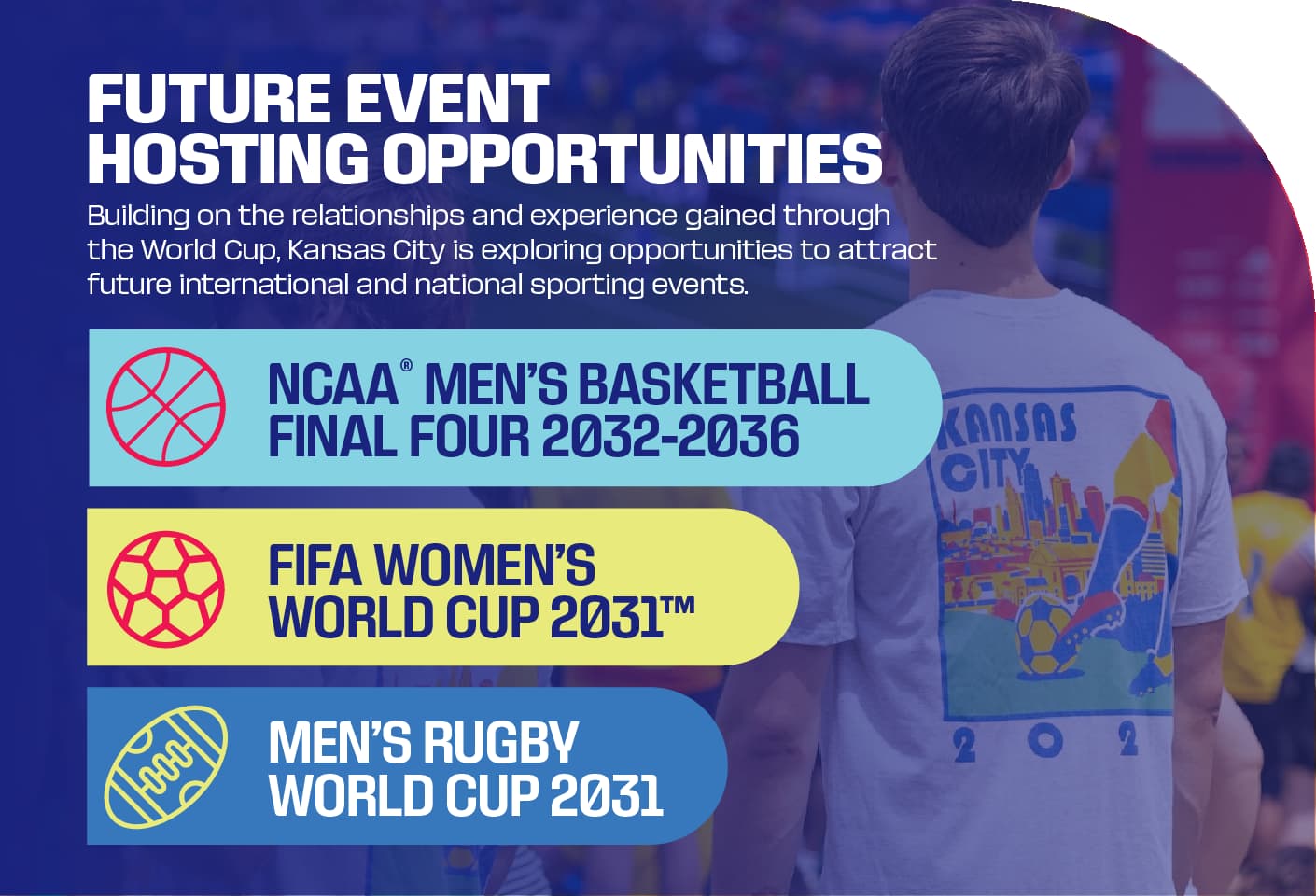
The KC2026 Board of Directors has established a Legacy Subcommittee to develop recommendations for turning the World Cup’s achievements into lasting benefits for the region. Its work is focused on three interconnected priorities: attracting major events, growing Kansas City’s sports economy and advancing youth sports excellence.
Together, these priorities reflect a long-term ambition to strengthen Kansas City’s position as a globally recognized sports capital, where sports contribute to our regional identity, economic vitality and quality of life for generations to come.
The subcommittee is evaluating how best to advance these priorities, with recommendations to follow as its work progresses. The goal is not simply to preserve what we accomplished, but to focus our collective leadership, investment and collaboration on opportunities that create lasting value for our businesses, communities and people.
Hosting the FIFA World Cup 2026 gave Kansas City more than the experience of delivering a global event. It deepened our understanding of our regional strengths, the conditions that create economic opportunity and the partnerships and preparation required for future success. These seven lessons provide a foundation for continued learning and more informed decisions.
Regional collaboration is essential
Kansas City’s strength as a destination for sports, business and investment comes from the collective assets and efforts of our cities, counties, states and civic partners. Our sports venues, entertainment districts, hospitality infrastructure and visitor experiences extend across state lines. Successful hosting requires a unified effort—not only in planning and delivery, but also in securing funding, sharing responsibilities and creating opportunities throughout the region. The World Cup demonstrated what we can accomplish by working together, providing a model for pursuing transformative economic development, attracting investment and advancing major infrastructure initiatives.
Our region has the capacity to do more
The World Cup demonstrated that Kansas City has the infrastructure, hospitality resources and operational capacity to host major events while continuing to welcome business travelers, leisure visitors and other sporting events. Future organizers of major events can plan with greater confidence and communicate that our region remains open for business, encouraging residents and visitors to participate rather than avoid the area in anticipation of crowds or inconvenience.
Experience creates better planning precedents
Hosting an event of this magnitude brought opportunities and complexities that were difficult to anticipate. The novelty created uncertainty surrounding visitor behavior, spending and demand, which presented challenges for organizers, communities and businesses. We now have firsthand experience and valuable data to strengthen forecasting, improve our understanding of when and where visitors generate demand, and support earlier, more informed decision-making.
Early public-private partnerships are critical
Major events can generate significant economic and reputational benefits, but realizing that potential requires early alignment among public agencies, private investors and event organizers. Securing funding commitments, defining responsibilities and understanding commercial rights and restrictions early in the process are essential to creating a sustainable hosting model and maximizing opportunities for regional participation.
Economic opportunity is not evenly distributed
Major events can generate substantial regional economic activity, but the benefits are not experienced equally by every business, industry or community. The World Cup reinforced that increased visibility and access to opportunity do not automatically translate into increased revenue. Businesses are ultimately responsible for identifying and pursuing opportunities, taking advantage of available resources and preparing to capitalize on event-related demand. Improved demand forecasting, timely market intelligence and a better understanding of visitor behavior can help businesses make informed decisions.
Local conditions should shape local strategies
Successful community activation and business participation require approaches tailored to local conditions. Proximity to event venues, visitor patterns, transportation access and community assets all influence opportunities. Future efforts should continue to build on this understanding, helping communities and businesses identify and pursue opportunities that align with their unique strengths and circumstances.
Lasting impact requires long-term commitment
The World Cup brought together regional partners, strengthened international relationships and demonstrated Kansas City’s ability to deliver on a global stage. Turning these achievements into lasting value will require dedicated leadership, continued collaboration and focused investment. By building on the relationships, capabilities and global visibility established through the tournament, Kansas City has an opportunity to strengthen its position as a global center for sports, business and culture.
THE KC HEART GATEWAY™ LIVES ON
A SYMBOL OF KANSAS CITY’S HOSPITALITY.
The KC Heart Gateway™ became one of the defining symbols of Kansas City’s hospitality and culture, welcoming fans from around the world and celebrating the spirit of our region.
Although the original structure was dismantled following FIFA Fan Festival, its story doesn’t have to end there.
Building on interest from communities and organizations across the region, KC2026 is developing a licensing structure that would allow partners to recreate the KC Heart Gateway using design specifications prepared by Populous.
From new installations to smaller replicas, the Heart could continue to serve as a symbol of Kansas City’s hospitality, regional pride and the connections highlighted as a FIFA World Cup 2026 host city.
THE NEXT CHAPTER FOR THE KC HEART GATEWAY™
KC2026 is developing a licensing process for partner organizations and municipalities interested in constructing a Heart installation or producing replicas using the approved design.
Details on design specifications, licensing requirements and availability will be shared as the program is finalized.